

Opening Context
Few movement architectures are as closely tied to a manufacture as Girard-Perregaux’s Tourbillon with Three Bridges. Its origins reach back to Constant Girard’s work in the 1860s, when the normally hidden bridges of a movement were transformed into a visible part of the watch’s design. More than a century later, the Opera One took that signature architecture into considerably more complicated territory.
Reference 99750-52-000-BA6A combines the Three Bridges tourbillon with one of traditional watchmaking’s most demanding acoustic complications: a Westminster carillon minute repeater. Housed in a 40 mm rose gold case, it is a watch in which the movement is not simply the mechanism beneath the dial; it is effectively the dial itself.
Why This Reference Matters
The Opera One is important because it brings together two disciplines that are individually difficult to execute. The tourbillon is suspended within Girard-Perregaux’s recognisable three-bridge architecture, while the minute repeater uses four hammers and four gongs to reproduce a Westminster-style sequence when striking the quarters. The mechanism can be observed through the openworked display, turning the chiming sequence into something both audible and visual.
Inside is the manually wound Calibre GP9899, a 37-jewel movement beating at 21,600 vibrations per hour and providing approximately 75 hours of power reserve. It is an unusually ambitious calibre even within the world of grand complications, combining the Three Bridges tourbillon and Westminster repeater within a relatively restrained case diameter.
On the Wrist
At 40 mm, the Opera One is surprisingly contained considering the complexity inside. The rose gold case gives the watch substantial presence, but its dimensions remain far removed from the oversized cases sometimes associated with modern grand complications.
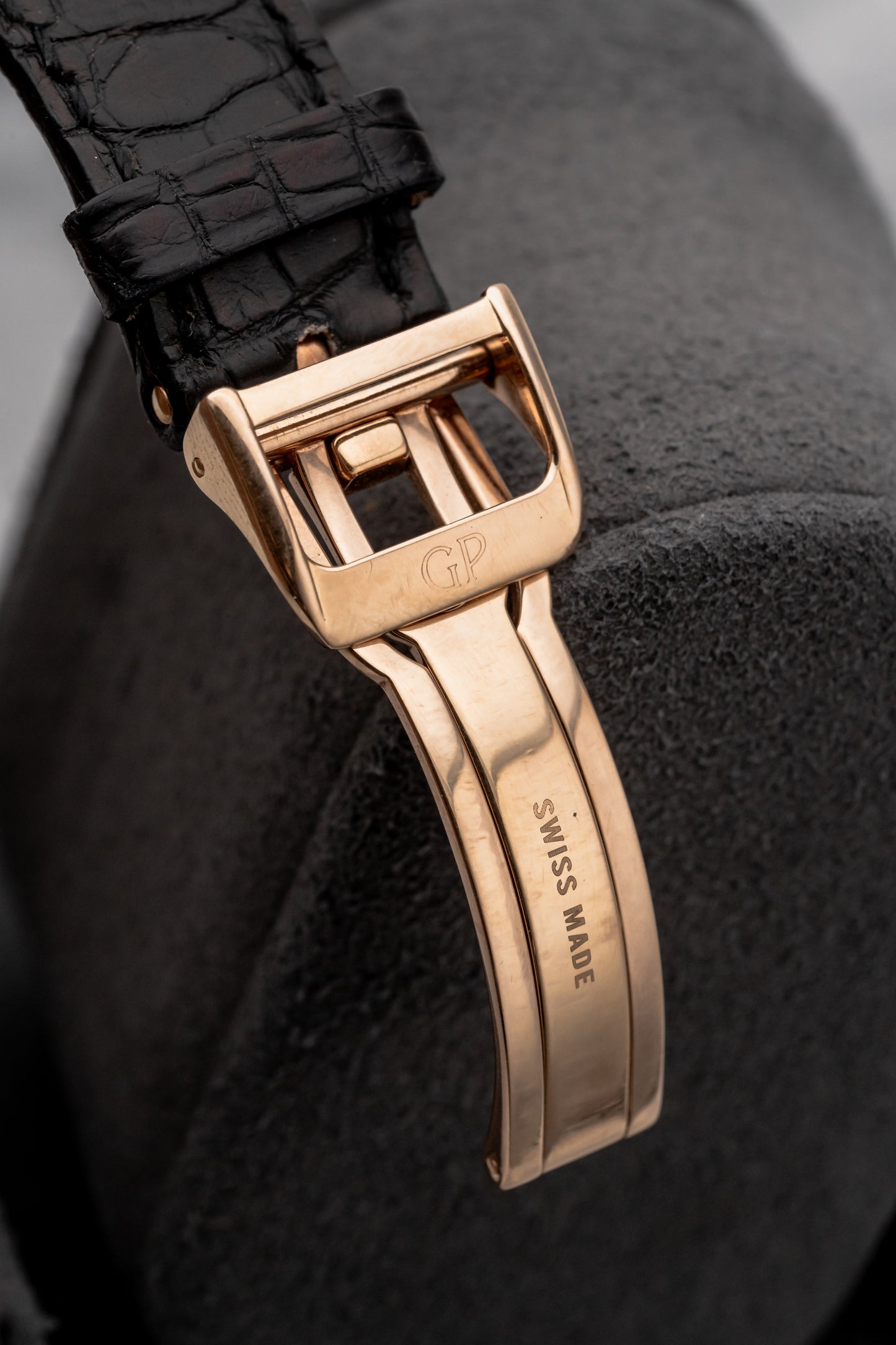
The openworked dial naturally commands attention. Three rose gold bridges provide a strong visual axis, while the tourbillon and repeater mechanism introduce constant mechanical depth beneath them. On a black leather strap with matching rose gold folding clasp, the watch retains enough formality to balance what is happening mechanically.
This is not a discreet watch in the conventional sense, but neither does it rely on size for impact. Its presence comes from seeing—and hearing—the movement operate.
Condition & Transparency
This example is presented on a black leather strap with an 18K rose gold folding clasp. Specific information regarding case condition, polishing history, crystal condition, movement condition, box and papers, individual production or case number, and previous servicing has not been provided. These details should therefore not be assumed. Given the complexity of the GP9899 and its repeating mechanism, confirmed service history and correct operation of the striking works are particularly relevant considerations for any individual example.
Why It Belongs in a Collection
The Opera One is suited to a collector whose interest has moved beyond complication counting and toward the different disciplines of traditional watchmaking. It brings together visual architecture, tourbillon construction and acoustic watchmaking in a single piece without abandoning one of Girard-Perregaux’s most historically recognisable designs.
Within a broader collection, it occupies territory few watches can. A conventional tourbillon can demonstrate regulation and finishing; a minute repeater introduces sound. The Opera One adds the identity of the Three Bridges and allows those elements to interact openly on the wrist. It is consequently as much a study in mechanical theatre as it is a complicated timekeeper.
Closing
The Girard-Perregaux Opera One 99750-52-000-BA6A represents the Manufacture operating at one of its most ambitious levels. Three rose gold bridges, a tourbillon, a four-gong Westminster carillon minute repeater and the manually wound GP9899 are brought together within a 40 mm rose gold case. For collectors drawn to Girard-Perregaux’s deeper history, it is a particularly complete expression of the Maison’s ability to turn movement architecture into identity.